
Thursday, June 28, 2012

Monday, June 25, 2012
Saint Elizabeth

Saint Elizabeth
Mother of John the Baptist
Mother of John the Baptist
("God is an oath" — Exodus 6:23).
Zachary's wife and John the Baptist's mother; was "of the daughters of Aaron" (Luke 1:5), and, at the same time, Mary's kinswoman (Luke 1:36), although what their actual relationship was, is unknown. St. Hippolytus (in Niceph. Call., Hist. Eccles., II, iii) explains that Sobe and Anna, their mothers, were sisters, and that Sobe had married a "son of Levi". Whether this indication, probably gathered from some apocryphal writings, and later on adopted by the compilers of the Greek Menologium, is correct, cannot be ascertained. Elizabeth, like Zachary, was "just before God, walking in all the commandments and justifications of the Lord without blame" (Luke 1:6). She had been deprived, however, of the blessings of motherhood until, at an advanced age, a son was promised her by the Angel Gabriel (Luke 1:8-20). When, five months later, Elizabeth was visited in her home by the Virgin Mary, not only was her son sanctified in her womb, but she herself was enlightened from on high to salute her cousin as "the mother of my Lord" (Luke 1:43). According to some modern critics, we should even attribute to her the canticle "Magnificat". After the birth and circumcision of John the Baptist, the Gospels do not mention Elizabeth any more. Her feast is celebrated on 8 September by the Greeks, and 5 November in the Latin Church.
Sunday, June 24, 2012
Saint John's Day - There was a man sent from God whose name was John.

Juan Fernandez de Navarrete
1565 and 1570
A Sermon by
St. Augustine (A.D. 354-430)
The Church observes
the birth of John as in some way sacred; and you will not find any other
of the great men of old whose birth we celebrate officially. We celebrate
John’s, as we celebrate Christ’s. This point cannot be passed over
in silence, and if I may not perhaps be able to explain it in the way that
such an important matter deserves, it is still worth thinking about it a
little more deeply and fruitfully than usual.
John is born of an old woman who is barren; Christ is born of a young woman who is a virgin. That John will be born is not believed, and his father is struck dumb; that Christ will be born is believed, and he is conceived by faith.
I have proposed some matters for inquiry, and listed in advance some things that need to be discussed. I have introduced these points even if we are not up to examining all the twists and turns of such a great mystery, either for lack of capacity or for lack of time. You will be taught much better by the one who speaks in you even when I am not here; the one about whom you think loving thoughts, the one whom you have taken into your hearts and whose temple you have become.
John, it seems, has been inserted as a kind of boundary between the two Testaments, the Old and the New. That he is somehow or other a boundary is something that the Lord himself indicates when he says, The Law and the prophets were until John. So he represents the old and heralds the new. Because he represents the old, he is born of an elderly couple; because he represents the new, he is revealed as a prophet in his mother’s womb.
You will remember that, before he was born, at Mary’s arrival he leapt in his mother’s womb. Already he had been marked out there, designated before he was born; it was already shown whose forerunner he would be, even before he saw him. These are divine matters, and exceed the measure of human frailty.
Finally, he is born, he receives a name, and his father’s tongue is loosed. Zachary is struck dumb and loses his voice, until John, the Lord’s forerunner, is born and releases his voice for him. What does Zachary’s silence mean, but that prophecy was obscure and, before the proclamation of Christ, somehow concealed and shut up? It is released and opened up by his arrival, it becomes clear when the one who was being prophesied is about to come. The releasing of Zachary’s voice at the birth of John has the same significance as the tearing of the veil of the Temple at the crucifixion of Christ. If John were meant to proclaim himself, he would not be opening Zachary’s mouth. The tongue is released because a voice is being born – for when John was already heralding the Lord, he was asked, Who are you and he replied I am the voice of one crying in the wilderness. John is the voice, but the Lord in the beginning was the Word. John is a voice for a time, but Christ is the eternal Word from the beginning.

St. John the Baptist
Leonardo da Vinci
Commerating Saint John the Baptist
The Nativity of the Holy Forerunner and Baptist of the Lord, John: The Gospel (Luke. 1: 5) relates that the righteous parents of St John the Baptist, the Priest Zachariah and Elizabeth (September 5), lived in the ancient city of Hebron. They reached old age without having children, since Elizabeth was barren. Once, St Zachariah was serving in the Temple at Jerusalem and saw the Archangel Gabriel, standing on the right side of the altar of incense. He predicted that St Zachariah would father a son, who would announce the Savior, the Messiah, awaited by the Old Testament Church. Zachariah was troubled, and fear fell upon him. He had doubts that in old age it was possible to have a son, and he asked for a sign. It was given to him, and it was also a chastisement for his unbelief. Zachariah was struck speechless until the time of the fulfillment of the archangel's words.
St Elizabeth came to be with child, and fearing derision at being pregnant so late in life, she kept it secret for five months. Then her relative, the Virgin Mary, came to share with her Her own joy. Elizabeth, "filled with the Holy Spirit," was the first to greet the Virgin Mary as the Mother of God. St John leaped in his mother's womb at the visit of the Most Holy Virgin Mary and the Son of God incarnate within Her.
Soon St Elizabeth gave birth to a son, and all the relatives and acquaintances rejoiced together with her. On the eighth day, in accordance with the Law of Moses, he was circumcised and was called John. Everyone was amazed, since no one in the family had this name. When they asked St Zachariah about this, he motioned for a tablet and wrote on it: "His name is John." Immediately his tongue was loosed, and St Zachariah glorified God. He also prophesied about the Coming into the world of the Messiah, and of his own son John, the Forerunner of the Lord (Luke. 1: 68-79).
After the Nativity of our Lord Jesus Christ and the worship of the shepherds and the Magi, wicked king Herod gave orders to kill all male infants. Hearing about this, St Elizabeth fled into the wilderness and hid in a cave. St Zachariah was at Jerusalem and was doing his priestly service in the Temple. Herod sent soldiers to him to find out the abode of the infant John and his mother. Zachariah answered that their whereabouts were unknown to him, and he was killed right there in the Temple. Righteous Elizabeth continued to live in the wilderness with her son and she died there. The child John, protected by an angel, dwelt in the wilderness until the time when he came preaching repentance, and was accounted worthy to baptize the Lord.
Orthodox Church of America
Friday, June 22, 2012
Eleanor, Franklin, Dylan & Woody


New York, NY, USA — Folk singer Bob Dylan, center, performs with drummer
Levon Helm, left, Rick Danko, second left, and Robbie Robertson of The
Band at Carnegie Hall in New York City on Jan. 20, 1968. The concert is
part of a benefit tribute to the late folk singer-songwriter Woody
Guthrie. It was Dylan's first public appearance after his motorcycle
accident in Aug. 1966.
(AP)

"Woody Guthrie, born on July 14, 1912 in the Okemah, Oklahoma, remains one of the most revered singers, songwriters and social activists in American history, a man whose gritty songs about the nation's also-rans have been translated into dozens of languages, covered by scores of other famous and talented musicians, and sung alongside a million smoky campfires between mouthfuls of coffee, whiskey or S'mores. And it all starts and ends with his masterwork"
Read more about the Woody Guthrie Centennial @ The Atlantic
Dylan singing Guthrie's tribute to Franklin Roosevelt
at the Tribute to Woody Guthrie concert at Carnegie Hall, January 1968.
Dear Mrs. Roosevelt
Words and Music by Woody Guthrie
Words and Music by Woody Guthrie
Dear Mrs. Roosevelt, don't hang your head and cry;
His mortal clay is laid away, but his good work fills the sky;
This world was lucky to see him born.
His mortal clay is laid away, but his good work fills the sky;
This world was lucky to see him born.
He's born in a money family on that Hudson's rocky shore;
Outrun every kid a-growin' up 'round Hyde Park just for fun;
This world was lucky to see him born.
Outrun every kid a-growin' up 'round Hyde Park just for fun;
This world was lucky to see him born.
He went away to grade school and wrote back to his folks;
He drew such funny pictures and always pulling a joke;
This world was lucky to see him born.
He drew such funny pictures and always pulling a joke;
This world was lucky to see him born.
He went on up towards Harvard, he read his books of law;
He loved his trees and horses, loved everything he saw;
This world was lucky to see him born.
He loved his trees and horses, loved everything he saw;
This world was lucky to see him born.
He got struck down by fever and it settled in his leg;
He loved the folks that wished him well as everybody did;
This world was lucky to see him born.
He loved the folks that wished him well as everybody did;
This world was lucky to see him born.
He took his office on a crippled leg, he said to one and all:
"You money changin' racket boys have sure 'nuff got to fall;"
This world was lucky to see him born,
"You money changin' racket boys have sure 'nuff got to fall;"
This world was lucky to see him born,
In senate walls and congress halls he used his gift of tongue
To get you thieves and liars told and put you on the run;
This world was lucky to see him born,
To get you thieves and liars told and put you on the run;
This world was lucky to see him born,
I voted for him for lots o' jobs, I'd vote his name again;
He tried to find an honest job for every idle man;
This world was lucky to see him born,
He tried to find an honest job for every idle man;
This world was lucky to see him born,
He helped to build my union hall, he learned me how to talk;
I could see he was a cripple but he learned my soul to walk;
This world was lucky to see him born.
I could see he was a cripple but he learned my soul to walk;
This world was lucky to see him born.
You Nazis and you fascists tried to boss this world by hate;
He fought my war the union way and the hate gang all got beat;
This world was lucky to see him born.
He fought my war the union way and the hate gang all got beat;
This world was lucky to see him born.
I sent him 'cross that ocean to Yalta and to Tehran;
He didn't like Churchill very much and told him man to man;
This world was lucky to see him born.
He didn't like Churchill very much and told him man to man;
This world was lucky to see him born.
He said he didn't like DeGaulle, nor no Chiang Kai Shek;
Shook hands with Joseph Stalin, says: "There's a man I like!"
This world was lucky to see him born.
Shook hands with Joseph Stalin, says: "There's a man I like!"
This world was lucky to see him born.
I was torpedoed on my merchant ship the day he took command;
He was hated by my captain, but loved by all ships hands;
This world was lucky to see him born.
He was hated by my captain, but loved by all ships hands;
This world was lucky to see him born.
I was a Gl in my army camp that day he passed away,
And over my shoulder talkin' I could hear some soldier say:
"This world was lucky to see him born."
And over my shoulder talkin' I could hear some soldier say:
"This world was lucky to see him born."
I guess this world was lucky just to see him born;
I know this world was lucky just to see him born;
This world was lucky to see him born.
I know this world was lucky just to see him born;
This world was lucky to see him born.
© Copyright 1962 by Woody Guthrie Publications, Inc. & TRO-Ludlow Music, Inc. (BMI)
Woody Guthrie
Thursday, June 21, 2012
Goin' to Brownsville

My Grandmother with her Remington 22
at the Ilion Gun Club
July 1937
at the Ilion Gun Club
July 1937
I recently acquired this photo of my grandmother, Lil Brown, and was shocked but delighted to see her enjoying herself in such a way. I knew her mostly as a very peaceful religious woman who loved to sing Gospel songs and tend her flowers. She had a wonderful voice with a natural vibrato. Her voice rose above all the other voices of the congregation, but I loved listening to her most when sitting at her feet with my siblings and my cousins. One of her favorites was "In The Garden". I'll never forget the day she showed me the tiny black seeds of her Portulacas. I was only six years old at the time, and at that moment, I too became a lover of flowers. In this photo she is with her sister, Ida.
On the back is written "Mrs. Brown, Ilion Gun Club, Ilion, New York, July 1937".
Gramma, I searched all over tarnation and couldn't find hide nor hair of anyone who sings "In The Garden" better than you, so I offer you some Portulacas instead. You'll have to "settle" for Ry Cooder further on down the page.

Gramma, I searched all over tarnation and couldn't find hide nor hair of anyone who sings "In The Garden" better than you, so I offer you some Portulacas instead. You'll have to "settle" for Ry Cooder further on down the page.

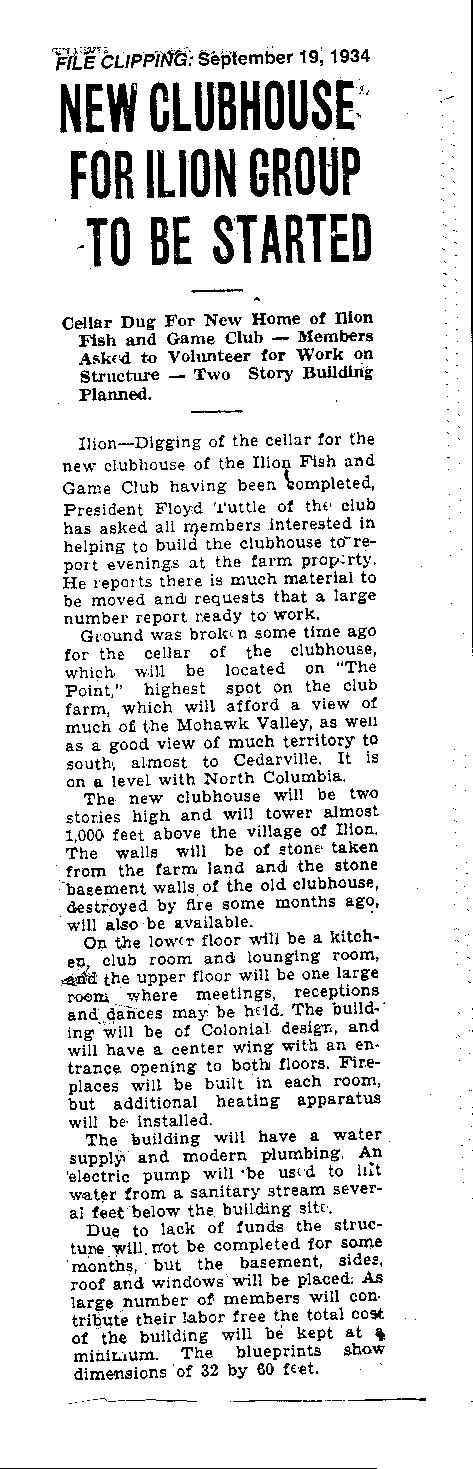
The original Ilion Fish & Game Club was founded in 1907. The
club grounds were actually located in downtown Ilion until 1926/27 when they
bought the Avery farm located on Barringer Road (which was across from the 1808
Remington Stone House) using the old farm house as the clubhouse. The
original clubhouse burned down in the early 1930’s and the current clubhouse
was erected in
1933/34
mostly by volunteers (except for the masons) using some
of the building material from the Philo Remington house. Around this time
there were approx. 1400 members and the annual dues were $1.50. Most of the
early records of the club have been eaten by mice and/or passed on by greatly
appreciated and missed deceased past members.
History of Ilion, New York
The village of Ilion is situated on the south bank of the Mohawk river in the town of German Flats. Although the town was first settled around 1725 by the German Palatinates, the first known establishment on the present site of Ilion was a store which was started by 1816. With the completion of the Erie Canal in 1825 the village began to really flourish. On the canal list it was called Steele's Creek, but it was also known as Morgan's Landing and there was an early settlement called "New London" for which the western part of the present day village was known for many years as "London."
In 1828 Eliphalet Remington (1793-1861) established a small factory for the manufacture of rifles. From 1830 to 1843 the village was known as Remington's Corners, and the first post office established in 1845 was named Remington. The village was incorporated under the name of Ilion in 1852 as Remington was opposed to the use of his name for the village. In 1856 the Remington company added the manufacture of farming tools, in 1870 sewing-machines and in 1874 typewriters. In 1874 with a population of about 2900 the village contained 2 hotels, a national bank, a brewery, a weekly newspaper and several schools and churches and was chiefly noted as the seat of the different Remington companies which employed a large number of men.
In 1910 with a population of about 6500, its principal manufactures were still the Remington typewriters and Remington firearms; other manufactures were filing cabinets and cases and library and office furniture (the Clark & Baker Co), knit goods, carriages and harness, and store fixtures. Many of these factories over the years harnessed the water of Steele's Creek to provide power for their machinery. By 1910 the village had a public library with about 13,500 volumes, a public hospital and a village hall and was served by the New York Central & Hudson river, West Shore railways, Utica & Mohawk Valley Electric railroad and the Erie Canal. The village owned its own water-works and its electric-lighting plant.
[written by Lisa Slaski; references used were "The American Cyclopaedia," by Charles Anderson Dana, 1874, page 180, "The Encyclopaedia Britannica," 11th Edition, Volume XIV, 1910, and the "History of Herkimer County," by George A. Hardin, 1893]

My Mother with Her Mother 1942
Sunday, June 17, 2012
May your heart always be joyful .... may your song always be sung ....

may you stay forever young

Happy Father's Day
Friday, June 15, 2012
Signora dei Pesci

Fisherman's Blues
The Waterboys
I wish I was a fisherman
tumblin' on the seas
far away from dry land
and it's bitter memories
castin' out my sweet line
with abandonment and love
no ceiling bearin' down on me
save the starry sky above
with light in my head
with you in my arms...
i wish i was the brakeman
on a hurtlin fevered train
crashin head long into the heartland
like a cannon in the rain
with the feelin of the sleepers
and the burnin of the coal
countin the towns flashin by
and a night that's full of soul
with light in my head
with you in my arms...
And I know I will be loosened
from the bonds that hold me fast
and the chains all around me
will fall away at last
and on that grand and fateful day
I will take thee in my hand
I will ride on a train
I will be the fisherman
With light in my head
You in my arms...
Light in my head
You in my arms...
Light in my head
You...
With light in my head
You in my arms...
Subscribe to:
Posts (Atom)